For authors
What actually works on Vox9
Numbers measured from the platform, 30 days to 17 September 2026
Most advice about publishing is folklore repeated until it sounds true. Everything on this page is either a measurement taken from Vox9 itself, or a feature you already have and may not know about. Where the numbers contradict the usual advice, they are marked, because those are the useful ones.
- When people actually listen
- Where your audience is
- Offer a yearly price
- Bring your Patreon supporters
- Cover art is not decoration
- Put chapters in a series
- Turn an episode into a video
- Writing for the narrator
- Scene images
- Vox9 Studios, free for you
- Make a book from a series
- Advertise on Vox9, free
- Credits, and why 100k is plenty
- Tell people where to find you
1. When people actually listen
Every hour of listening on Vox9 over the last 30 days, by hour of the day, UTC:
Hour of day, UTC. Gold is the peak.
The honest version: posting time matters far less than you have been told. The quietest hour of the day still carries 51% of the busiest hour's listening. That is a remarkably flat curve, and it means a large share of listening is background, commute and overnight rather than people sitting down at a particular moment.
If you want the small edge, publish so your episode is live before 20:00 UTC. If you publish at a different time because that is when you finish writing, you are giving up very little. Consistency is worth more than timing.
And be careful with day-of-week advice. Wednesday looks like the biggest day on Vox9 by a distance. Take the platform's single largest serial out of the figures and the difference between the best and worst day shrinks to about 20%. Most of that spike is one author's release schedule, not a day when the world wants to listen. Pick a day and keep it; your readers will learn it.
2. Where your audience is
Two things follow from that, and neither is "write American".
- Your evening is not their evening. A UK author publishing at 9pm local is publishing at 4pm US Eastern, which is close to ideal. An Australian author publishing after dinner is hitting the quietest part of the curve.
- Nearly half your audience is not American. British, Canadian and Australian listeners are almost a fifth of the platform between them. Spelling and idiom from your own country are not a problem here.
3. Offer a yearly price
A supporter pays for the whole year in one go, at a discount, and you collect the entire year up front. They get a saving, you get twelve months of income today instead of twelve chances for someone to lapse in month three.
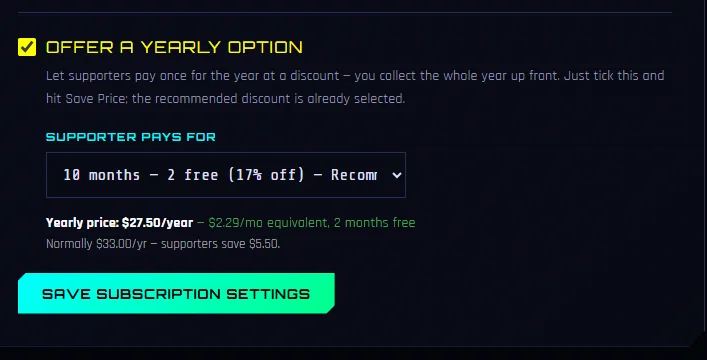
Your dashboard, Settings, under your subscription price. Tick it, pick a discount, save.
The recommended discount is already selected, so this is genuinely two clicks. Ten months for twelve is the default because it is the one people recognise: two months free reads as generous without costing you much, since a yearly supporter who would otherwise have lapsed at month four was never going to pay you for ten.
One thing to know before you switch it on. Yearly money arrives as one payment, which is excellent for you and means a refund is handled by hand rather than automatically. If someone asks for one, email us and we will sort it. It is rare, but it is better to know now than to find out during it.
4. Bring your Patreon supporters
If you already have paying supporters on Patreon, you can let them unlock your Vox9 subscriber episodes without paying twice. They connect their Patreon account once, and anything they are already entitled to over there opens up here.
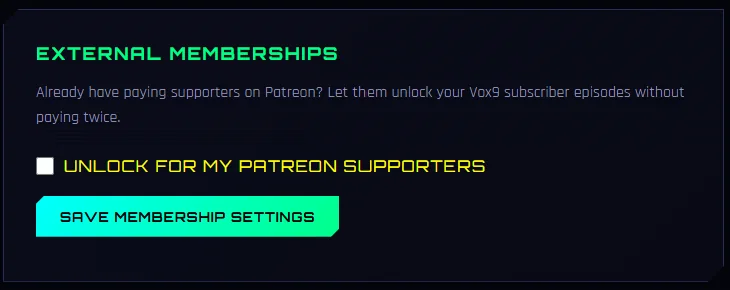
Your dashboard, Settings, External Memberships.
This is the one on this page that almost nobody has found: one author out of 109 has turned it on. The pitch to your own audience is a good one, because it costs them nothing and asks them to change nothing:
- Keep your Patreon. You are not moving anyone or asking them to cancel anything. Their pledge stays exactly where it is.
- They get the audio free. Someone paying you $3 a month on Patreon gets your early-access episodes here as audiobooks, at no extra cost.
- You reach people who will not sign up twice. A supporter who would never have started a second subscription is now listening, commenting and following.
Set a minimum pledge if you want, so only your paying tiers qualify. It is web only by design: a supporter connects once on the website and their episodes are unlocked everywhere, including in the app, because the entitlement lives on our side rather than theirs.
5. Cover art is not decoration
Be slightly sceptical of that number: only 30 published episodes have no cover at all, and an author who skips the cover may be skipping other things too. But the direction is not in doubt, and the reason is mechanical rather than aesthetic: a cover is what a browse row, a hub card and a shared link all display. An episode without one is rendered as a gap, and on some surfaces it is not rendered at all.
Give a series a cover too. A series without one cannot appear in Popular Series, which is one of the better places on the site to be found.
6. Put chapters in a series
If chapters of one book are uploaded as loose episodes, every reader who finishes one has to go and find the next themselves, and most will not. Inside a series they get the next chapter offered automatically, the series page holds the whole thing in order, and a single link sends a new reader to chapter one rather than to whatever you published most recently.
Worth knowing: a one-shot is fine as a standalone. The 2× gap is about continuation, not about series being magic. A short story with nothing after it loses nothing by standing alone, and it gets its own filter on the hub.
7. Turn an episode into a video
New in September. Every episode with audio has a 🎥 button in your dashboard. It opens that episode in Vox9 Studios with the narration, captions and artwork already loaded, and you export an MP4 for YouTube, TikTok, Instagram or anywhere else.

The third button along, on every episode that has audio.
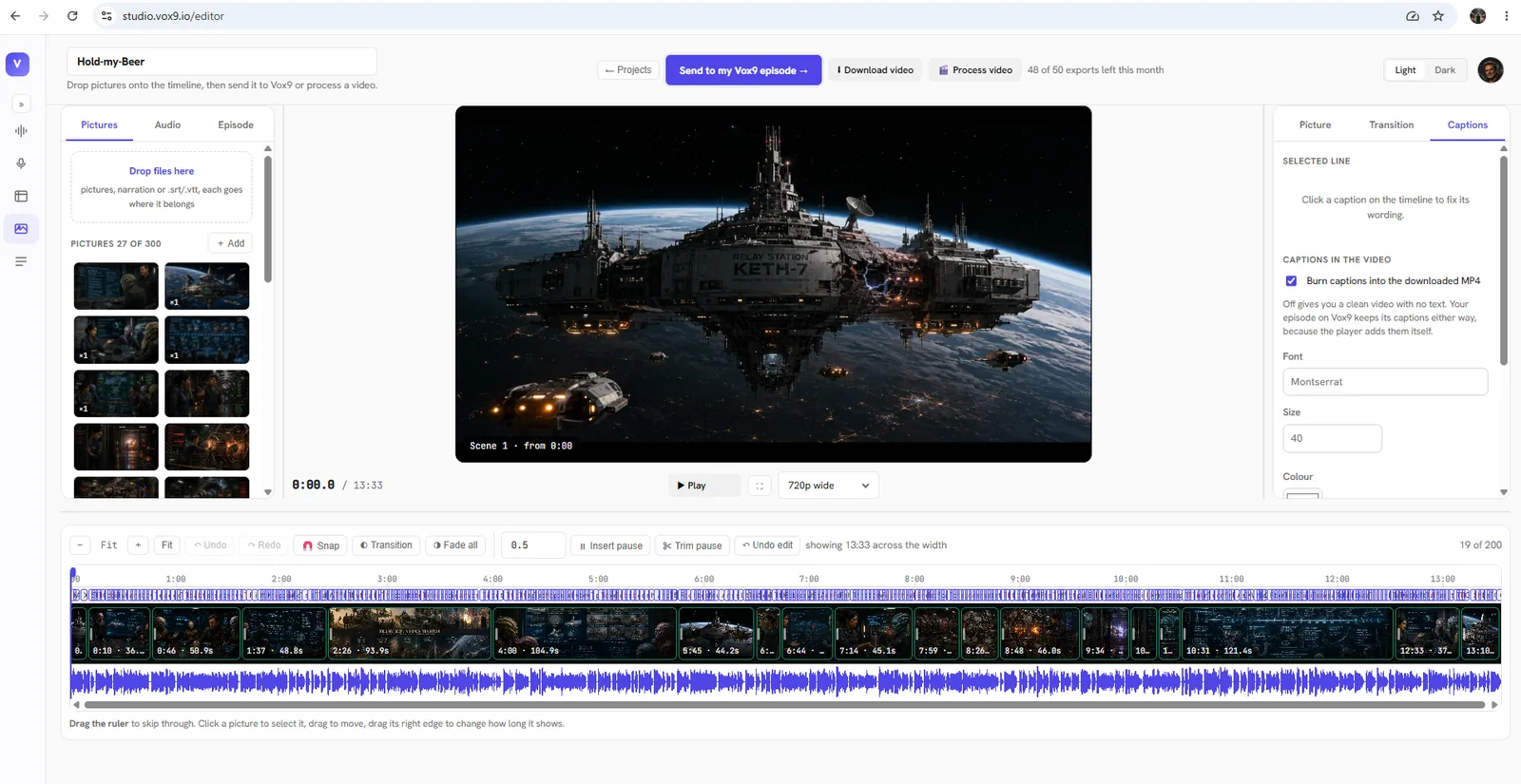
What the button opens. Pictures down the left, the timeline along the bottom, and Send to my Vox9 episode or Download video at the top. Note the export counter in the corner: 50 a month, because you are a Vox9 author.
- Nothing about your episode changes. The video is a file you download. Make as many versions as you like.
- 720p, with a small Vox9 Studios watermark. That is the same for everyone at the moment, including us.
- Up to 90 minutes long, 50 exports a month, because being a Vox9 author lifts you above the free limits automatically.
- You will be asked to sign in to Studios the first time in a browser. That is deliberate: passing your sign-in through the link would leave it sitting in your browser history and it would expire within the hour, quite possibly part-way through a render.
- It works on drafts, so you can cut a trailer before an episode goes live.
8. Writing for the narrator
The narrator reads what you typed, not what you meant. These are the formatting habits that make AI narration sound deliberate rather than flat.
Capitals for emphasis
"This is EXACTLY what I was looking for."
Double hyphens for a hard pause or an interruption
"I was just about to -- wait, did you hear that?"
Ellipsis for hesitation and trailing off
"Maybe we should... no, never mind."
One caveat worth knowing: an ellipsis ends a sentence as far as the narrator is concerned, so the words after it are read fresh rather than as a continuation. That is usually what you want for hesitation. It is not what you want mid-phrase.
Doubled punctuation for intensity
"Stop right now!!"
"Are you serious?!"
End a paragraph on ... or -- for a longer beat
She never looked back.
Then the screaming began.
Strip special characters, because they get read aloud
This is the one that catches everybody. The narrator will attempt to pronounce them.
Remove or rewrite: * / # ~ _ { } [ ] < > Scene breaks written as *** or --- are the most common offender, because they are invisible to you and spoken by the narrator.
A habit worth building
Read the first minute back before you publish. Almost every narration problem is audible in the first sixty seconds, and it is the sixty seconds that decides whether a new listener stays. If something is wrong, fix the text and generate again rather than living with it.
9. Scene images
Scene images appear over the player at timings you choose, so a long episode is not a static square for an hour. 211 episodes have them so far, which means it is still a way to stand out rather than the norm.
Two ways in:
- By hand: the Edit tab of any episode in your dashboard. Upload images and set the time each one appears. There is a Create empty tiles shortcut that lays out slots at a fixed interval, which beats typing timestamps one at a time.
- From a video you already made: Vox9 Sync at studio.vox9.io. Drag the video in and it pulls out the audio, the images and the scene timings, adds captions, and sends the result to your dashboard as a draft for you to publish.
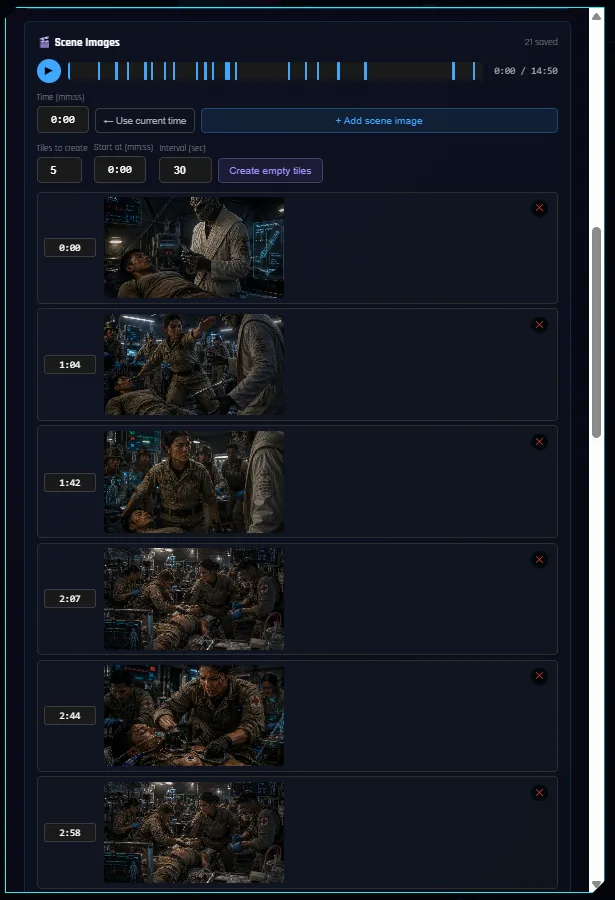
Scene Images in the Edit tab. Each image gets a timestamp, and the bar at the top shows where they land.
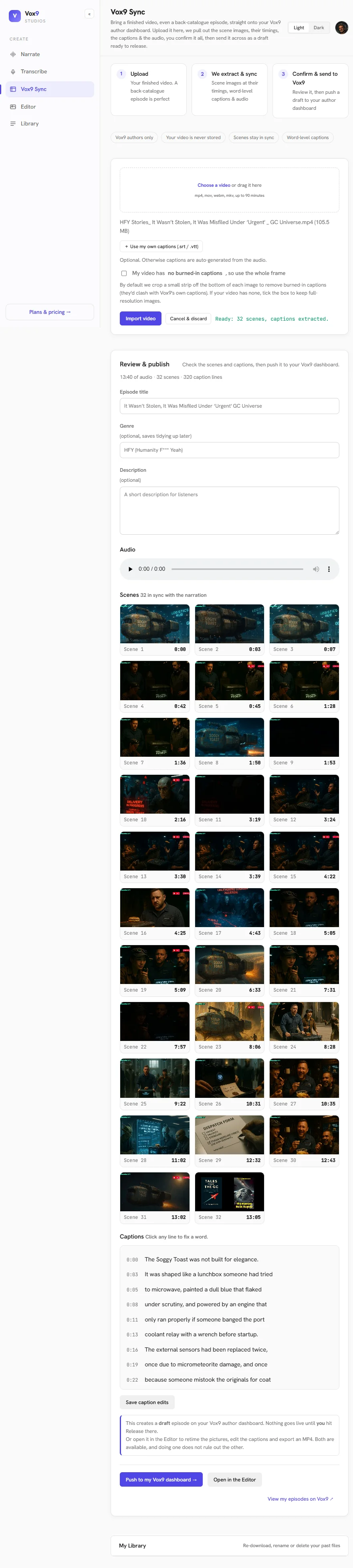 Click to see the whole page
Vox9 Sync, top to bottom. A 13 minute video went in; 32 scenes came out with their timings, 320 caption lines were written, and one button pushes the lot to your dashboard as a draft. Nothing goes live until you hit Release.
10. Vox9 Studios, free for you
studio.vox9.io is a separate toolkit, and being a published Vox9 author unlocks it without paying. Four tools:
Narrate
Text to speech with the same voice library you use here. Useful for anything that is not a Vox9 episode: a trailer, an author's note, a sample.
Transcribe
Audio or video in, accurate word-level captions out. Useful if you narrate yourself and want captions without typing them.
Vox9 Sync
A finished story video in, a Vox9 draft out: audio, scene images, timings and captions, straight into your dashboard. This is the fastest route if your work already exists on YouTube.
The Editor
Narration, pictures and captions on a timeline. Publish a draft to Vox9 or export an MP4. This is what the 🎥 button opens.
11. Make a book from a series
A series can be turned into a single long book, either the whole thing or a selection of episodes from it. Useful when a serial finishes and you want one object people can start at the beginning of, rather than forty chapter links.
12. Advertise on Vox9, free
A display card puts your cover and a link into the browse hub, on the website and in the app. There is also audio pre-roll, a short spot before someone else's episode, which is the format that works hardest: listeners finish about 83% of them.
Set it up from the advertising page in your dashboard. You can top up your own credit in $10, $25 or $50 steps, it does not expire, and anything unspent is refunded if you ask.
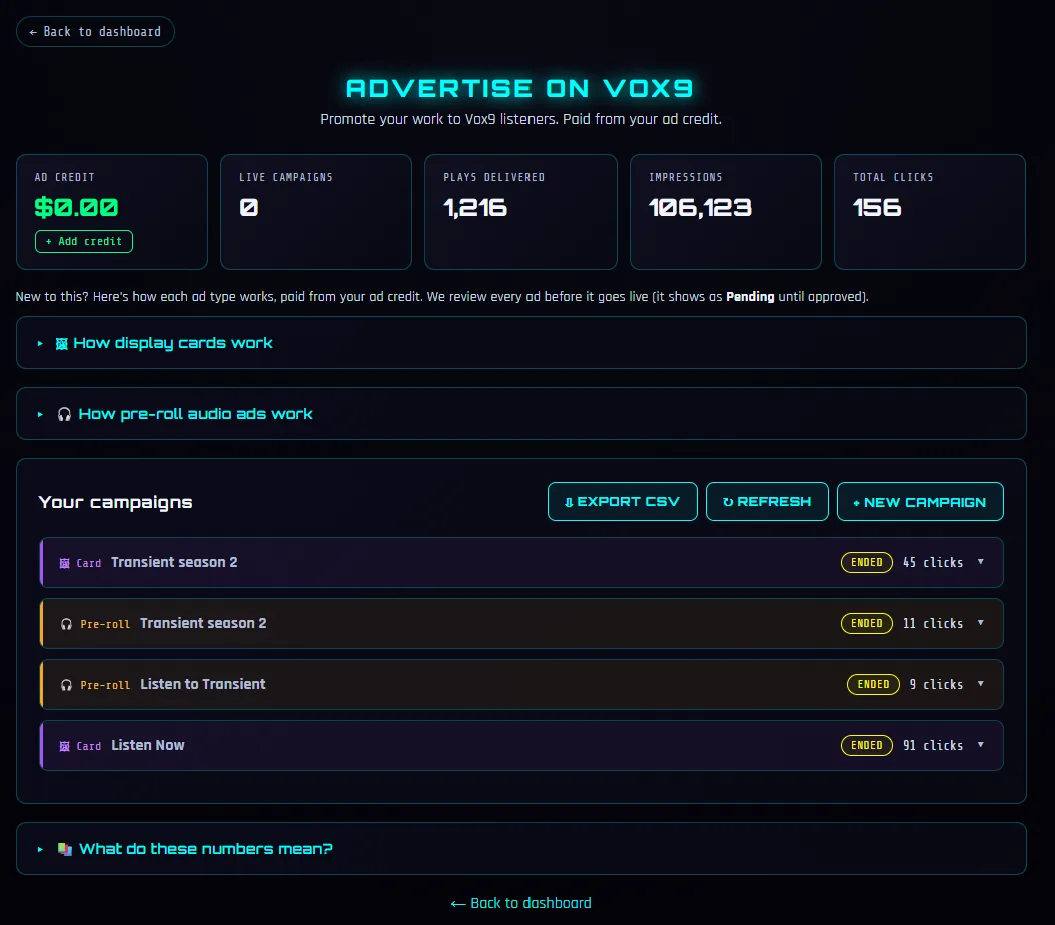
The advertising page. Every campaign is reviewed before it goes live, and the per-campaign click counts are what you should judge a campaign on, not impressions.
Read clicks, not impressions. The page above shows 106,123 impressions against 156 clicks. That is normal and it is not a disappointment: a display card is seen far more often than it is acted on. Audio pre-roll converts several times harder than a card, so if you only try one format, try that.
13. Credits, and why 100k is plenty
Credits are characters of narration, charged when you generate. 100,000 is roughly 17,000 words a month, which is four or five decent chapters. You can buy more if you are writing at pace, but on the evidence almost nobody needs to.
Deleting an episode does not refund its credits. They are spent at the moment of generation. This is the single most common surprise, and it is why proofreading before you generate is worth more than it looks: a regenerated chapter costs you the chapter twice.
14. Tell people where to find you
This is the one that actually moves numbers, and the one most authors skip.
Your author page is the link to share. Not an episode, not the front page. It holds everything you have written, it works for someone who has never heard of Vox9, and since September it no longer asks a visitor to sign in before they can listen. If you have a Royal Road following, a subreddit, a Discord or twelve people who like your writing, that is the address to give them.
🔗 Copy it in one click
There is a Share your author page button beside the title on your dashboard's Library screen. Press it and the link is on your clipboard, ready to paste into a comment, a Discord, a video description or an email signature. It looks like vox9.io/author.html?u=yourname and it does not expire.
A single comment saying "I record these as audiobooks, they're here" does more than any feature on this page. The platform grows when your readers arrive, and your readers arrive when you tell them where to go.
Every figure here was measured from Vox9 over the 30 days to 17 September 2026, except the country split, which covers 718,714 classified plays over a longer period. Numbers move. If something here stops matching what you see in your own dashboard, your dashboard is right and this page is stale: tell us at support@vox9.io and we will fix it.